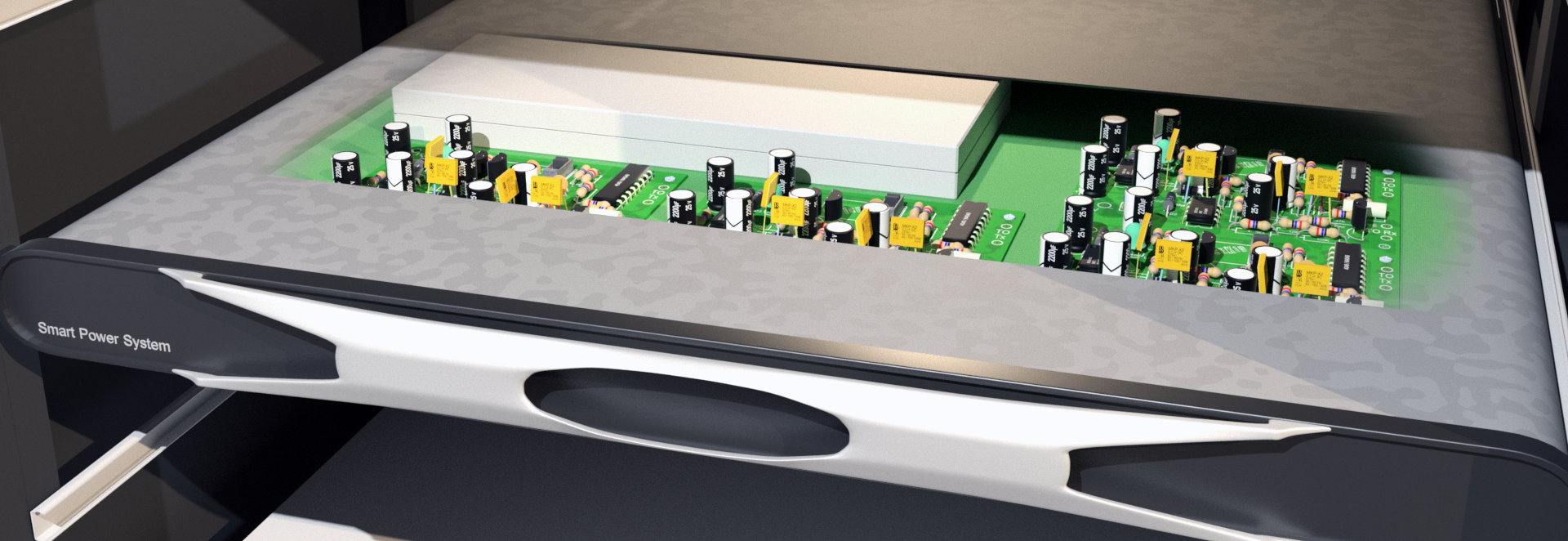
The Smart Power System is a power distribution unit with built-in surveillance capabilities that is able to prioritise between multiple consumers connected to the output circuits of the product, ensuring that the most vital equipment stays online the longest. The product was specifically designed to be implemented in a power distribution system that utilises a backup power source, where batteries are often used. When such systems switch over to the backup source, a lot of power is often wasted on equipment that isn't critical to keep online. The Smart Power System overcomes this issue by allowing the user of the system to set up prioritised output circuits, to make sure that the available backup power is reserved for where it is needed the most.
The product can be connected with two power sources, where the intended setup is a main power source and a backup power source in case the main source is disconnected or unavailable. The system then distributes up to a total of four output circuits. When the main power source is connected and is meeting the power demand, the system works as a regular power distribution unit, delivering the power needed by the consumers on the outputs of the system. However, in the absence of the main power unit, the system automatically switches over to the backup power unit without any of the consumers on the system outputs experiencing a power outage. When the system is distributing power from the backup power source, the system switches over to its emergency mode. This means that the system is making sure that the prioritised output circuits is kept online for as long as possible, where the priority of the output circuits can have lower or higher priorities that each other.
The Smart Power System is connected to a local server which is sending and receiving information from the system hardware. The server is equipped with a user interface which allows the user of the system to set up prioritised power outputs with different levels of priority, as well as monitoring the available amount of power on the backup batteries and how much power is being consumed in real-time. The user also receives alarms and warnings about the power consumption and availability through the user interface.
• 2 power source inputs
• 4 prioritised output circuits
• Emergency mode if the main power source is absent
• User defined limits and power handling
• Intuitive user interface
• Connect to the system server through a computer
• Sturdy and reliable design
• Fits in a 19'' rack
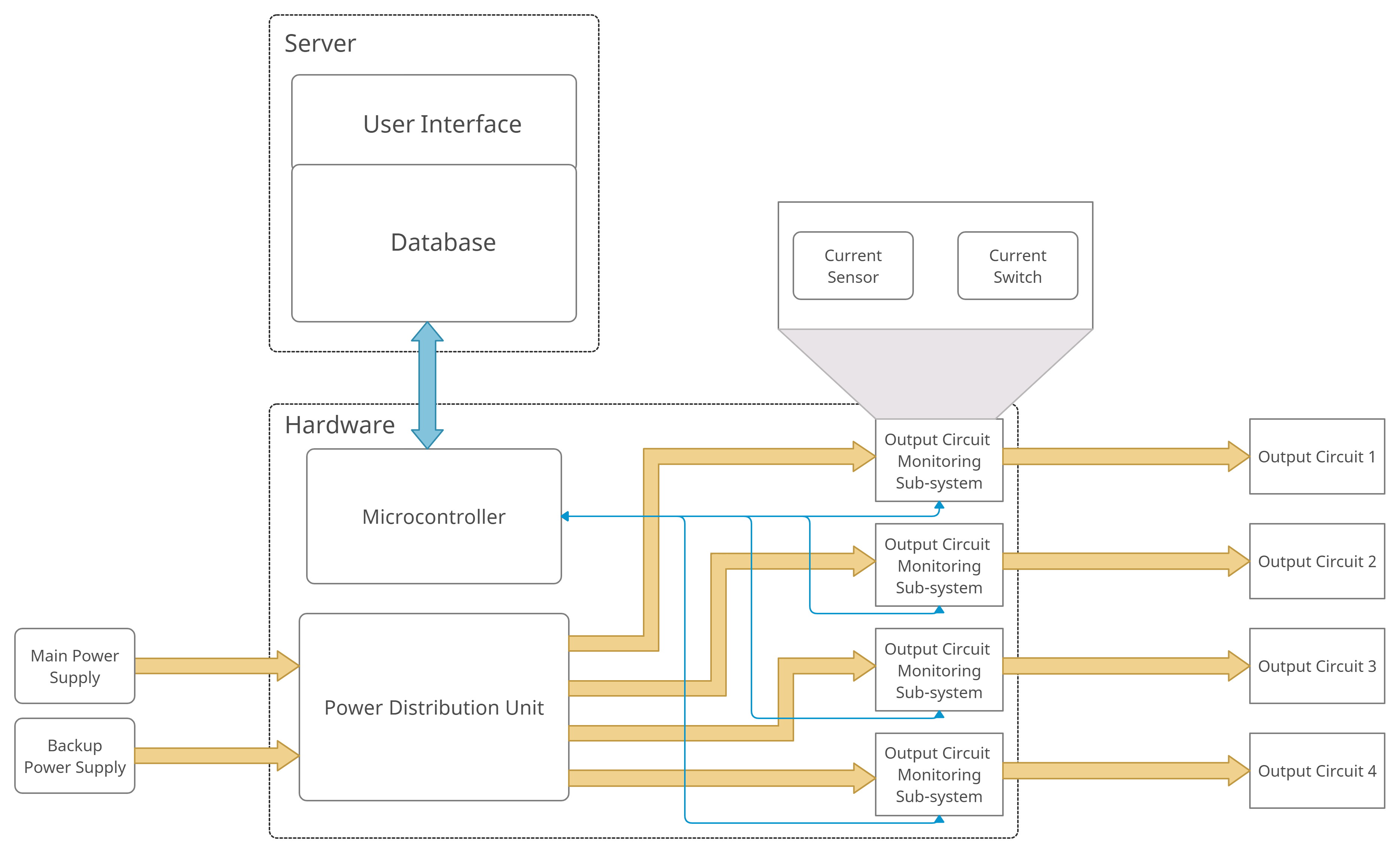
User interface: Allows the system user to monitor the power consumption and availability. Also lets the user control the system settings regarding the prioritisation.
Database: Communicates between the user interface and the microcontroller. Stores and processes data from these two as well.
Microcontroller: Processes the analog data and controls the switches.
Power Distrubution Unit: Distribution Unit: Distributes power, switches from the main power source to an alternate when it’s required.
Output Circuit Monitoring Sub-system: CContains the current sensor and current switch.
Current Sensor: Measures current through each circuit.
Current Switch: Handles switching each circuit on or off with a signal from the microcontroller.